
Scott Pilgrim EX is Trying to Evolve a Cult Classic Without Breaking It
When Scott Pilgrim vs. the World The Game arrived in 2010, it did something few licensed titles manage to pull off. It became a cult classic not because of the IP attached to it, but because it nailed the spirit of arcade brawlers in a modern format. Tight combat, co op chaos, and pixel art attitude made it a fixture in dorm rooms and online lobbies for more than a decade.
Scott Pilgrim EX now has a release date of March 3, and on the surface it looks like a familiar return. Underneath, however, it represents something more ambitious: an attempt to modernize the beat em up without turning it into something unrecognizable.
This is not just another Scott Pilgrim game. It is a deliberate redesign of what a co op brawler can be in 2026.
A Franchise With Unusual Staying Power
The Scott Pilgrim universe has always existed in an unusual space between indie sensibility and mainstream appeal. The original graphic novels became cultural staples. The movie cemented the characters in pop culture. The 2010 game quietly outlived them both, thanks to its digital re release and a dedicated community that kept replaying it.
That longevity matters. Beat em ups are not known for long tails. They are typically consumed, finished, and forgotten. Scott Pilgrim broke that pattern because it made players feel like they were part of something performative, social, and replayable.
Tribute Games, the studio behind Scott Pilgrim EX, understands that history. Their previous work has consistently focused on preserving arcade DNA while modernizing systems around it. EX is the studio’s biggest attempt yet to walk that line.
Why an Open City Changes Everything
The biggest shift in Scott Pilgrim EX is structural rather than cosmetic. Instead of moving from stage to stage, players explore a city split into interconnected districts ruled by rival factions.
That single decision quietly rewrites how a beat em up functions.
Traditional brawlers are about momentum. You move forward, clear enemies, and get pushed toward the next screen. EX replaces that linear pressure with choice. Players can backtrack, take side objectives, hunt for upgrades, and decide how they want to approach the city.
This turns combat into a resource loop. Fights are no longer just obstacles. They become opportunities to earn coins, experiment with builds, and prepare for harder encounters elsewhere.
It is the difference between an arcade cabinet and a role playing game with fists.
How the New Fighters Reflect a Different Design Philosophy
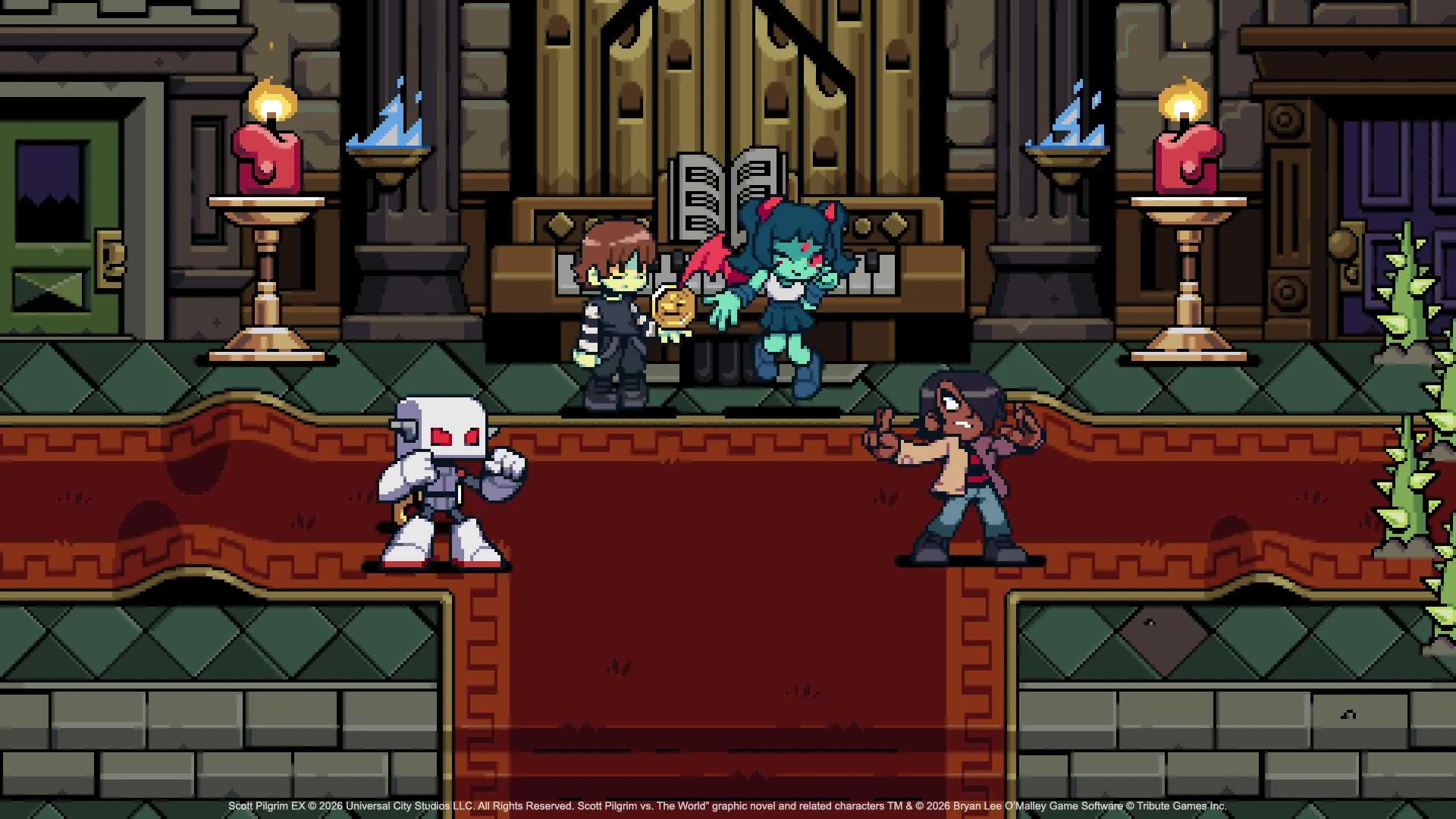
The reveal of Matthew Patel and Robot 01 is more telling than it looks.
Matthew Patel is built around spectacle. Summons, flames, crowd control, and dramatic finishers make him less about raw damage and more about controlling the battlefield. He rewards positioning, timing, and team synergy.
Robot 01, by contrast, is about speed and screen control. Thrusters, morphing limbs, and projectile patterns let the player dictate where enemies can move and where they cannot.
These are not palette swaps. They are tactical archetypes.
In older beat em ups, characters were defined mostly by stats. In EX, they appear designed around roles. That is a subtle but important shift toward co op depth rather than co op chaos.
Systems First Not Power Creep
One of the more interesting design choices in Scott Pilgrim EX is that every fighter has their full move set from the start. Progression comes from customization, not from unlocking basic functionality.
This avoids a common trap in modern action games. Gating core abilities behind progression can make early gameplay feel incomplete. EX instead allows players to express themselves immediately, then refine their playstyle over time through badges and stat adjustments.
From a design standpoint, this keeps co op balanced. New players are not dead weight. Veterans are not forced to babysit. Everyone can contribute, even if they specialize differently.
It is a smart way to keep skill, not grind, at the center of the experience.
The Role of Music and Narrative
Anamanaguchi returning for the soundtrack is more than fan service. Their sound defined the identity of the original game, blending chiptune energy with modern production.
Coupled with story contributions from Bryan Lee OMalley, EX is positioning itself as a continuation of tone rather than a simple sequel. The plot about Sex Bob Omb being kidnapped and their instruments stolen is intentionally absurd, but it provides a city wide motivation that ties exploration to narrative.
That matters because an open structure without narrative glue can feel hollow. EX is trying to give players reasons to care about why they are revisiting districts and chasing side objectives.
What This Means for the Co Op Community
Local and online four player co op is where Scott Pilgrim EX could live or die.
Modern co op games often struggle with drop in drop out functionality, progression syncing, and role differentiation. EX appears designed to address all three. Character builds persist. Exploration rewards curiosity. And different fighters fill different niches.
For long time fans, this could create something the original game never quite achieved: a reason to keep playing after the credits roll.
For new players, the open structure lowers the barrier to entry. You are not forced to memorize levels. You are invited to explore.
Industry Context Why This Matters Now
Beat em ups have quietly returned over the past decade, but most of them lean heavily on nostalgia. Scott Pilgrim EX is trying something riskier. It is using nostalgia as a foundation, not a crutch.
That places it closer to games like Streets of Rage 4 or TMNT Shredders Revenge in spirit, but further in ambition. Those games perfected the classic formula. EX is attempting to evolve it.
If it succeeds, it could influence how licensed action games are built going forward. If it fails, it will still stand as a rare attempt to push the genre forward.
Risks of Going Bigger
The biggest danger for Scott Pilgrim EX is scope. Open maps, multiple characters, progression systems, and co op synchronization all introduce complexity that arcade brawlers were never designed to handle.
If balance breaks, certain builds could trivialize content. If progression is too slow, the game could feel grindy. If co op syncing falters, the experience collapses.
These are not small risks. They are the cost of ambition.
A Calculated Evolution
Scott Pilgrim EX is not trying to replace its predecessor. It is trying to grow past it.
By blending classic beat em up combat with open ended exploration, role based fighters, and long term progression, Tribute Games is betting that fans are ready for something deeper without losing what made the franchise special.
March 3 will not just be another release date. It will be a test of whether a cult classic can become a modern co op platform without losing its soul.