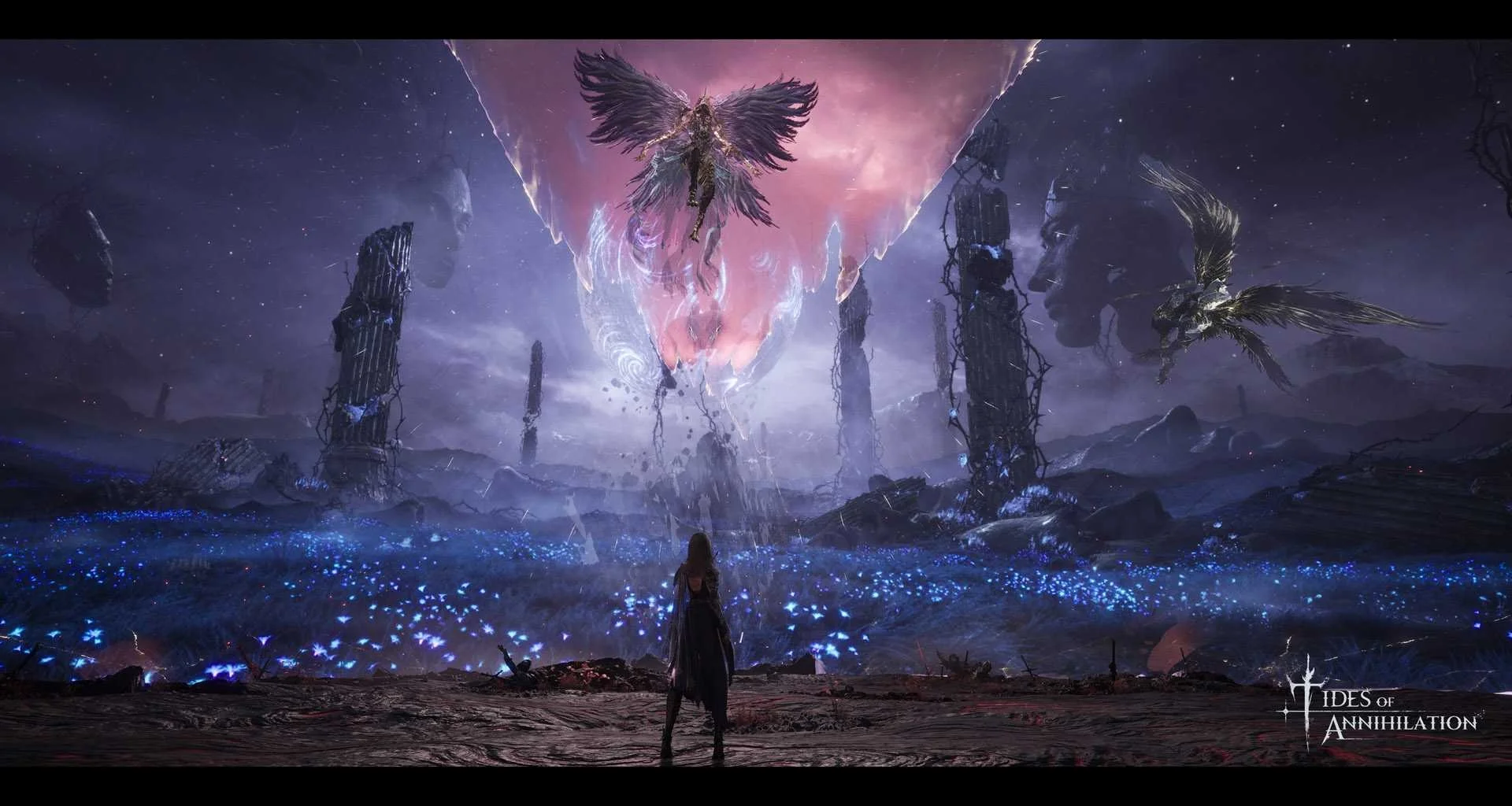
The latest wave of next‑generation action titles has found an unlikely standout — Tides of Annihilation, an upcoming project from Chinese developer Eclipse Glow Games. During the Xbox Partner Preview on November 20, the studio debuted a brand‑new trailer that instantly caught viewers’ attention. It showcased swirling fantasy landscapes, dazzling particle effects, and complex dimension‑shifting combat mechanics reminiscent of Bayonetta and Devil May Cry. Yet what truly stirred discussion across communities was its signature set‑piece: a surreal, Inception‑style boss fight that bends space and mirrors realities in ways few third‑person games have dared.
In the clip, the protagonist Gwendolyn engages in a multi‑stage encounter with a towering creature named Tyronoe, The Ferryman, whose design feels lifted from a dream — or possibly a nightmare. She battles alongside Knight Lamorak, the second playable hero introduced so far, seamlessly flipping between parallel dimensions throughout the fight. These cinematic transitions aren’t just visual flourishes; they represent the heartbeat of the game’s Dual Frontline Battle System, a mechanic allowing players to command two combatants and weave their attack chains as worlds collapse around them.
The demonstration’s pacing immediately evoked the high‑speed elegance of Bayonetta — the rhythmic dodges, the rapid animation bursts, and the controlled chaos characteristic of S‑tier action games. Unlike more traditional hack‑and‑slash titles, Tides of Annihilation appears designed around interlinked duos rather than solitary heroes, inviting players to master harmony between combinations and dimensional swaps. Each shift temporarily rewrites the battlefield, giving sight lines into mirrored realms that pulse with abstract geometry. The overall presentation feels simultaneously mythic and cybernetic: Avalon’s medieval roots fused with London’s shattered metropolis following a mysterious “Outworld invasion.”
A Blurring of Worlds and Eras
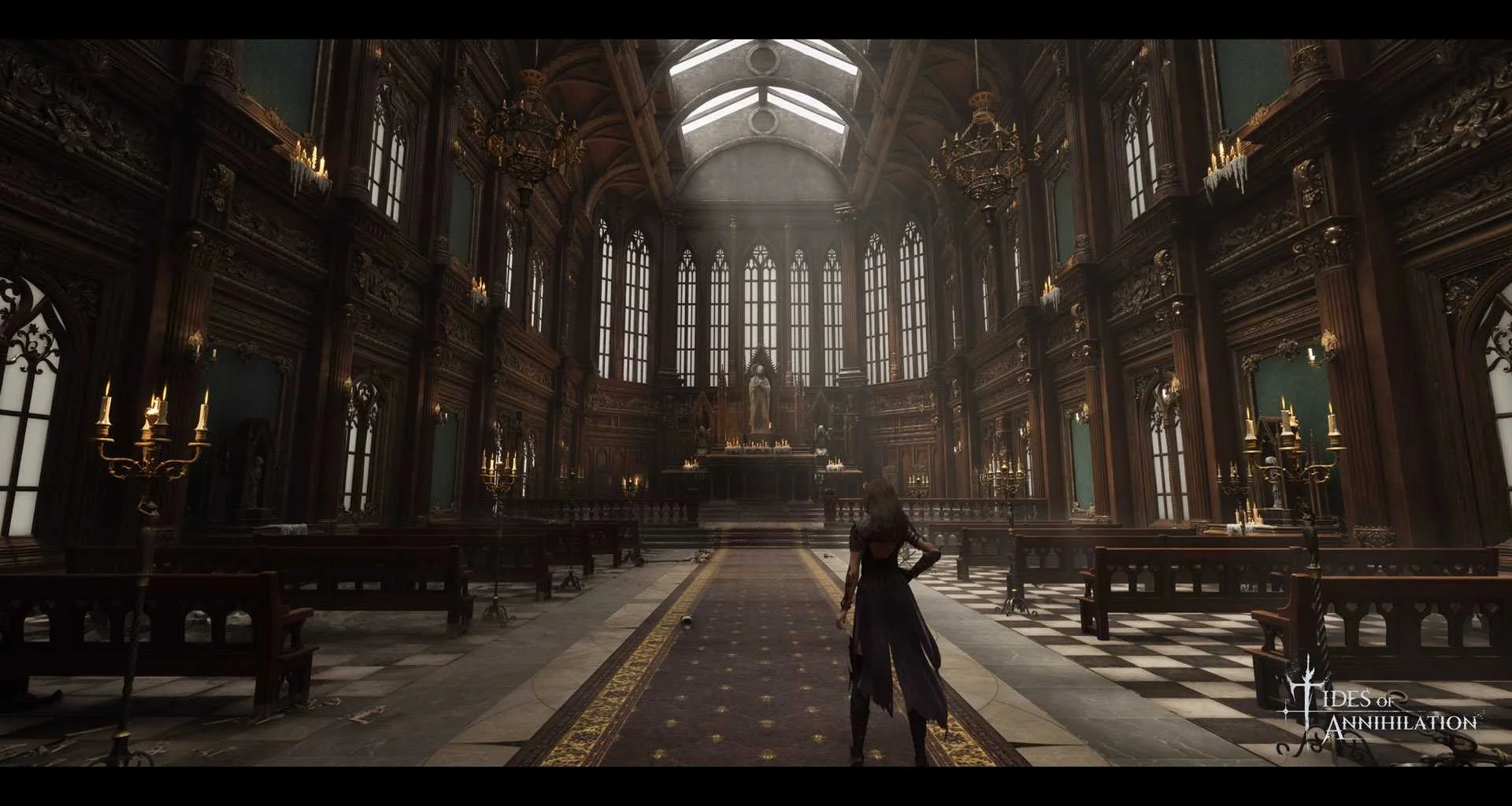
This duality defines the game’s narrative identity. Tides of Annihilation unfolds across two distinct settings — a mythic Avalon inspired by Arthurian legend, and a modern London transformed by interdimensional upheaval. Players alternate between these zones as the storyline intertwines knights, echoes of history, and the consequences of scientific experimentation gone wrong. It is fantasy dressed in futuristic tech, and the November showcase positioned it as one of the most ambitious genre hybrids coming to consoles in 2025.
Eclipse Glow first announced the title during Sony’s February 2025 State of Play event, immediately sparking debate about China’s growing presence in premium AAA‑grade production. While the studio remains relatively new, Tides of Annihilation displays craftsmanship and scope typically associated with veterans. From the kinetic camera choreography to the expressive attack animations, every frame appears hand‑tuned to amplify momentum. In contrast to some slower action RPGs, the game thrives in velocity.
The developer describes combat tempo as “elastic acceleration.” The two fighter system creates a continuous motion string — dodging, swapping dimensions, executing finishers, then returning through mirrored portals that reshape gravity. According to early reactions during the preview, the encounter with Tyronoe hints at a finely structured learning curve. His sweeping attacks are clearly signaled, granting accessibility even for players not acquainted with character‑action systems. That responsiveness may prove crucial if Eclipse Glow intends to appeal beyond hardcore hack‑and‑slash fans.
Gameplay Mechanics and Visual Personality
What distinguishes Tides of Annihilation most from contemporaries is its intertwining of environment logic and combat rhythm. When Gwendolyn drifts between dimensions, the arena’s structure mutates — stairs collapse backward, reflections distort enemy projectiles, and remnants of Avalon architecture fuse with neon London sprawl. These transitions are not cutscenes but gameplay triggers that reinforce immersion rather than interrupt it. Each swap between Gwendolyn and Lamorak resets cooldowns and renews chain possibilities, promoting creativity mid-fight.
This framework, labeled internally as the Dual Frontline Battle System, may eventually introduce co‑operative online scenarios, though that hasn’t yet been officially confirmed. Fans suspect that Eclipse Glow is teasing asynchronous multiplayer elements similar to Astral Chain’s linked partner concept. The developers have hinted that synergy between knights extends beyond combat into exploration puzzles, world traversal, and perhaps morality decisions influenced by dimensional alignment.
The November reveal simultaneously confirmed Tides of Annihilation as an Xbox Play Anywhere title, meaning buyers will enjoy seamless cross‑progression across Xbox Series X/S and PC using a single license. The studio also reaffirmed its partnership with Sony, promising a day‑one PlayStation 5 launch — a rare cross‑platform harmony for a debut studio operating at this production scale.
Behind the Scenes and Pricing Curiosity
Interestingly, Tides of Annihilation briefly made headlines earlier this year when it appeared on the Xbox Store for an unexpected $22.49 pre‑release price, far below standard AAA thresholds. The listing was quickly pulled in March, prompting refunds for all pre‑orders. No official price point has been declared, though sources within the industry anticipate a retail tag closer to premium benchmarks, citing extensive cinematography and fluid motion capture as costly investments. The incident nevertheless spurred speculation about release timelines and marketing strategy.
Since February, the game’s Steam page has simply read “Coming Soon,” accompanied by concept art of Gwendolyn standing amidst collapsing mirrors. That imagery has become symbolic — representing Eclipse Glow’s aesthetic ambition: merging reflective worlds where reality behaves like water under pressure.
Community Reaction and Genre Positioning
Following the new trailer, gaming circles erupted with positive sentiment. Action genre veterans described it as the “perfect collision of East and West design philosophies.” Many drew parallels with NieR: Automata for thematic density, Devil May Cry for movement precision, and Bayonetta for kinetic staging. But fans agree that Tides of Annihilation embodies its own DNA — less tongue‑in‑cheek, more operatic and philosophical.
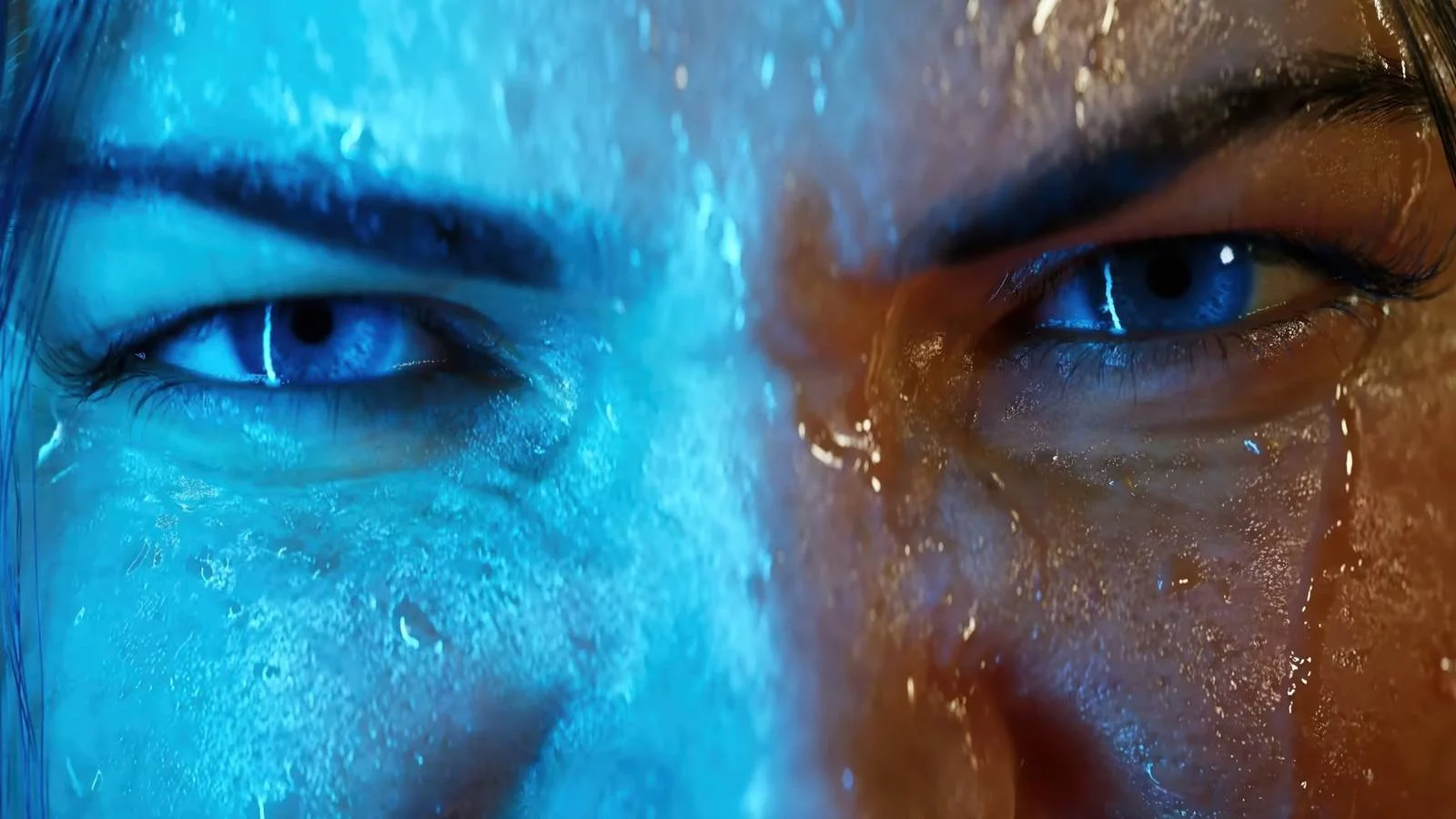
Commentators pointed out subtle cues of psychological storytelling baked within its “Mirror Space” mechanic. Each mirrored shift reflects Gwendolyn’s internal struggle against encroaching oblivion, grounding what might otherwise be pure spectacle in emotional subtext. The boss fight with Tyronoe is thus perceived not merely as mechanical escalation but as a metaphor for bargaining with fate — crossing rivers of death and rebirth in a literal and symbolic sense.
The game’s title itself, “Tides of Annihilation,” translates this motif into rhythm: waves of destruction and recreation oscillating endlessly. Whether set among Avalon’s mythic ruins or London’s fractured skyline, the game’s world visually narrates the balance between decay and renewal — classic poetry recomposed in code.
A New Benchmark for Chinese Studios
For decades, large‑format character‑action games were dominated by Japanese houses like PlatinumGames or Capcom. Eclipse Glow’s presence signals a widening field. Its production, reportedly led by former art directors from Honor of Kings and Bright Memory: Infinite, merges stylized realism with theatrical gesture. That cross‑pollination between Chinese art direction and Western mythic motifs could carve a distinct niche for Tides of Annihilation among 2025’s global lineup.
While no exact release is pinned, insiders predict late‑summer deployment. If the promise holds, the Xbox Play Anywhere model may let players jump between couch and desktop seamlessly, while PS5 users experience full DualSense integration. Developers hinted at adaptive trigger feedback tied to dimension shifts — pressure resistance literally rising as the player’s world bends inward.
Closing Thoughts
Ultimately, Tides of Annihilation appears poised to be more than another flashy action romp. It’s shaping into an experimental showcase for storytelling through motion — where combat choreography doubles as metaphor, and dimensional shatters mirror identity fractures. If Eclipse Glow can maintain its balance between accessibility and spectacle, this may well mark China’s next major stride into mainstream AAA territory.
The November trailer didn’t just flaunt technical showmanship; it reaffirmed that imagination remains gaming’s ultimate power. Between knights and reflections, between Avalon and apocalypse, Tides of Annihilation invites players not only to fight — but to navigate the rippling borders between destruction and rebirth.